

A Dozen-Plus Stimulants, Gathered for Your Edification and Inspiration
Dear Intelligent American,
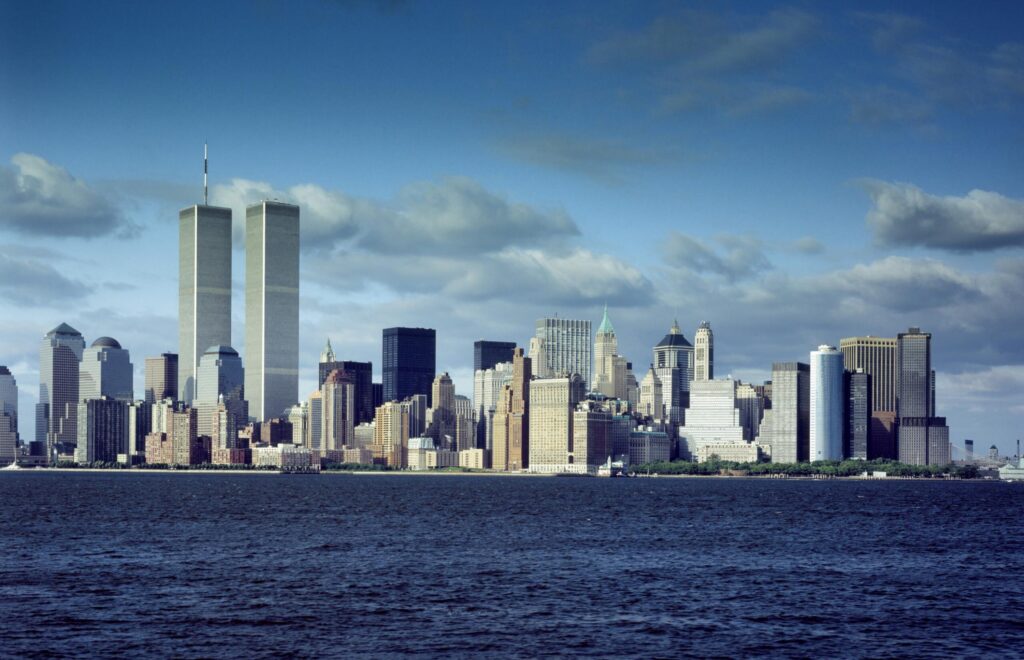
There are numerous vestiges and aftershocks of September 11th. One is a particular melancholy that comes at seeing a cloudless, bright blue sky. The night before back in 2001, a wild storm raged over New York and Connecticut, but it was one with that cleansing effect, “like the first morning . . . springing fresh from the Word.” In the fury’s wake was sun and calm and sweet air, so that Tuesday commenced with its most excellent canopy a dirty trick.
A problem with being proximate (in Manhattan, not near the Towers) to the massacre, and it was that, is a persisting guilt—yes, there was shock and fear that gripped you, but was this a badge of courage? Up at Lexington Avenue and 33rd Street, at least you did not face the choice of burning to death or falling to earth from the 80th floor or trying to outrun a toxic cloud while a skyscraper fell on you.
By the way, it seems almost obscene to call The Falling Man and other poor souls “jumpers.”
Late morning, all ordered to leave the island, with no trains running, a small band from National Review commenced what was figured to be a six-hour trek to The Bronx. And not knowing what other mayhem was to happen that day, a route was plotted: avoid proximity to Grand Central or the Empire State Building; get to Central Park. Drama came swiftly: Walking up Fifth Avenue, we stopped dead when a screaming mob (scores of panicked souls) poured out of 39th Street, yelling “A BOMB!” There was a strange personal calmness: “Well, this is where the ticket gets punched.” But there was no bomb (what caused the hysteria was never known), and the eternal ticket punching still awaits, and the sojourn continued. And it still does.
All those proximate to lower Manhattan or the Pentagon or in rural Pennsylvania have a story to tell. But at least we were around to tell it, post shocking facto. God rest all those who could not. And may He, in His Divine way, smack upside the head those who refuse to admit to that day’s terrible truth as to why this evil was visited upon us, and who perpetrated it.
Here Are Shared Some Recommended Readings, as Is This Journal’s Custom
1. At The Wall Street Journal, Ben Sasse says America’s kids need to be kicked out of the house. To play. From the piece:
Rather than introducing children to the world in an age-appropriate manner, we’re preventing them from developing imagination, resilience and grit. Allowed to navigate dark corners of the internet on their own, many kids are bizarrely prohibited from exploring their own neighborhoods. This overprotection, however well-meaning, prevents children from learning valuable lessons like overcoming boredom, conquering fear and taking risks.
Of the 12 Apollo astronauts who walked on the moon, 11 were Boy Scouts who had learned to live by the scout’s motto “Be Prepared.” We’re not raising these kinds of audacious risk-takers at present.
From westward expansion to space exploration, Americans have succeeded by pushing boundaries and embracing challenges. That kind of pioneer spirit starts with the adventures and misadventures of childhood. Stitches aren’t all downside.
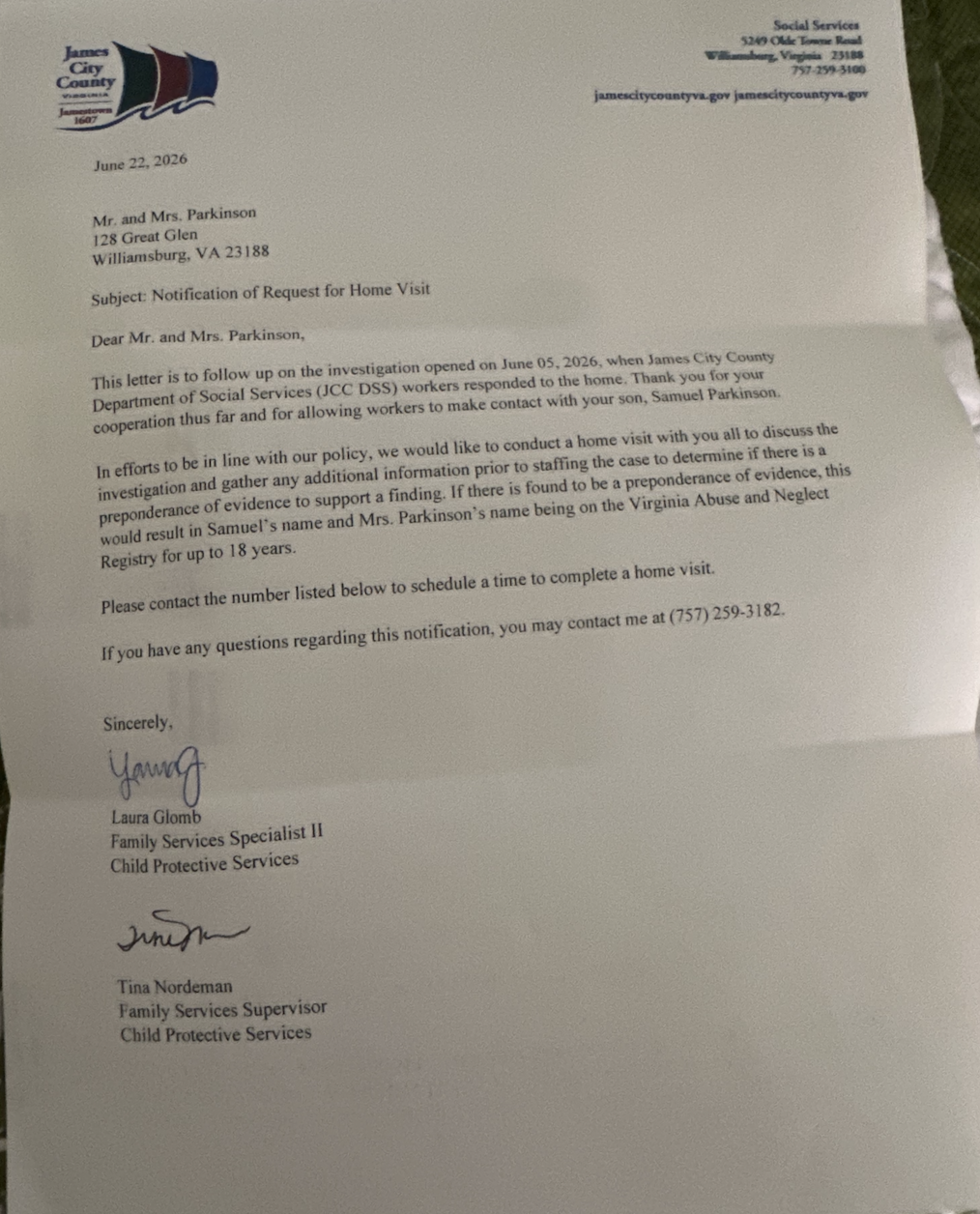
2. Meanwhile, at Reason, Lenore Skenazy reports on Virginia mom Karyann Parkinson getting convicted of allowing her son to do just that—play outside. From the article:
In June, when Parkinson was preparing for the bar—and also happened to be eight months pregnant with her fifth child—she and her then-youngest, Sam, went for a bike ride, as they often do. They stopped for her son’s favorite activity: collecting goose feathers from the path near their community pond. When they got home, he asked if he could walk back and get some more.
Parkinson said yes. It’s a short walk, along a sidewalk separated from the street by 10 feet of grass. Sam would have to cross two streets with crosswalks, which she'd seen him do safely hundreds of times—including six times that morning, she says. Off he went while she made lunch.
A passerby saw Sam and alerted security. One of the community’s security guards escorted the boy back and gave Parkinson an earful. Pretty soon there were three cop cars, just as many cops, a security vehicle, and two Child Protective Services (CPS) workers at Parkinson’s door.
CPS ended up investigating her for abuse and neglect.
The cops, meanwhile, charged her with contributing to the delinquency of a minor. CPS found the allegations substantiated and placed Parkinson on the state's child abuse and neglect registry. She will remain there for seven years.
3. At Tablet Magazine, Maggie Phillips warns that the druids are back. From the piece:
Druidry, in other words, has a long history of being reconstructed by people in the present to tell a story about what the past means. Modern Druids are doing the same thing, and many of them are quite candid about it.
Twentieth century Druidry emerged as a form of earnest spirituality with the work of Cambridge graduate Ross Nichols, who founded the Order of Bards, Ovates & Druids (OBOD), still in existence today. Together with Gerald Gardner, the founder of Wicca, Nichols developed the eightfold wheel, a cyclical annual calendar of festivals now widely practiced by Druids and other neopagans.
How these festivals are observed can differ radically. “Sometimes people get dressed in ritual wear and do a more formal ceremony with an opening and a closing, and like a shrine and various things,” O’Driscoll said. “But another form of ceremony might be a group of druids hiking into the woods, finding big trees and hanging out with them, playing music and having a frolic.”
4. At Law & Liberty, fan favorite Daniel J. Mahoney applauds the great scholar Harvey Mansfield. From the beginning of the review:
For more than fifty years, Harvey C. Mansfield Jr. has challenged progressive orthodoxy within and outside of the academy. A political theorist of the first rank, he is also a seasoned practitioner of traditional political science. The latter is an approach inspired by Aristotle’s Politics that takes its bearings from the perspective of citizens and statesmen, and never simply leaves that perspective behind. To cite another of Mansfield’s intellectual inspirations, Alexis de Tocqueville, such an approach aims to see “not differently but further than the parties.” This combination gives Mansfield’s work a remarkable depth, breadth, and relevance.
As a political scientist, Mansfield has defended what he terms America’s “constitutional soul,” opposed the hyper-democratic impulse to level vitally important distinctions, and manfully resisted the totalitarian impulse at home and abroad, including the ravages caused in recent years by the secular religion of “wokeness.” Through his teaching and his own example, he has demonstrated that excellence and equality need not be at war with each other, that liberal democracy, properly tutored, can open itself to what is highest in human beings and to what is highest simply.
5. More L&L: Michael Pakaluk enters the conversation about “common good,” and finds it has stars and stripes, and its notion is being abused. From the essay:
You probably haven’t noticed it, but we put all three of these common goods together in our Pledge of Allegiance: “one nation . . . indivisible” (the political common good); “under God” (the theological common good); “with liberty and justice for all” (the natural law common good). The Pledge even orders them classically: the natural law common good frames the political common good while subordinating it to the theological common good. (See St. Thomas Aquinas’s De Regno for the classic statement of this ordering.) If one wants to speak in this way—and traditionally this is how most ordinary Americans have wanted to speak—then one may construe a political community as in this way “under God” only if it recognizes a substantive right to religious liberty; robustly provides conditions for the free exercise of religion; keeps its laws concordant with the natural law; and, in its culture and laws, construes liberty as intended for the attainment of virtue in its citizens (not excluding intellectual virtue)—as in “confirm thy soul in self-control, thy liberty in law.”
Political actors who want to invoke the common good of American society, at least if they regard themselves as “conservatives,” would need to think and speak in something like this way. If they supposed that something else were “the” common good—say, what they took to be the desired outcome of their preferred industrial policy—then they would not be referring to the common good of American society. Recall that that good must sit atop a hierarchy of goods.
I say “the common good of American society” because another trait of goods is that they must be distinctive. Classically, Plato and Aristotle held that the good of a thing is idion, specific to that thing (see Republic I and Nic. Eth. I.7). So “the” common good of American society must be something specific to it. In our history and founding there is a distinctive way of conceiving the three common goods just discussed and their relation, and it is the task of a genuine conservative, in American society, to construe what these are, get their ordering right, and see how to restore and strengthen them today.
6. At Common Good (is there a theme here?), Christina Ray Stanton knows the World Trade Center site well, and historically. From the article:
If you’d told me in 1996 what would happen on September 11, 2001, I wouldn’t have believed you. And if you’d told me that 30 years later, I’d still be conducting walking tours of this complex, I would have been just as skeptical. But here I am, one of the only tour guides left in the industry who has toured both the old and new. The World Trade Center and I have both endured, been broken and remade. I am no longer just a guide to its history. I’ve been changed by it, shaped by it, tethered to it. I am part of it, and it’s a part of me.
Today, when I guide visitors through the site, the work is more layered than it once was. I narrate what stood there, what stands here now, and what is still being imagined. I speak the language of architecture and absence, of memorial and redevelopment. Woven through it all is my own story — of being here before, of escaping, of returning. The skyline has changed. The footprint has changed. Even the words we use have changed. What has not changed is the human need to remember why it matters. My work now is not simply to recall what was lost, but to interpret what has been rebuilt: architecturally, historically, and personally.
7. At Freedom Frequency, Andrew Roberts tells of Winston Churchill’s passion for preserving freedom. From the article:
Another recurring theme was the value of sacrifice. In a bloody war such as the one Britain was then enduring, it was clear that many would lose loved ones for the greater cause.
In his great speech of May 13, 1940, the first he delivered as prime minister, Churchill stated, “I have nothing to offer but blood, toil, tears, and sweat.” He went on to acknowledge, “We have before us many, many long months of struggle and of suffering,” and defined his policy as “to wage war . . . with all our might and with all the strength that God can give us.” He was definitively clear that no matter what would come to pass, his objective was “Victory. Victory at all costs . . . however long and hard the road may be.”
Churchill’s emphasis on sacrifice reflected his belief that in order to achieve total victory and freedom from Nazism, the country would require immense personal sacrifices from the British people. He rejected any illusion that the Nazis would be defeated without significant suffering from the Allied countries. Yet Churchill presented this sacrifice as a purposeful one, a price to preserve liberty. His speeches illuminated how he viewed self-sacrifice as absolutely essential to the survival of the British nation. By connecting the ideas of freedom and sacrifice, rather as Pericles had in his Funeral Oration in Athens in 431 BC, Churchill ensured that his listeners recognized liberty not just as a passive abstract idea, but also as something that required great self-sacrifice and hardship if it was to be saved.
8. At National Review, the great David Mamet ages with futility, and fears the America that was is not the America that will be. From the reflection:
Yes, history will repeat itself—what else does it have to do?
The no-good brother-in-law, once lent money, will always come back for more; a Western world in upheaval will reliably savage the Jews; and communism, promulgated by the intellectually arrogant, will always appeal to the bored wealthy. They will use their money to inform their pets, the working class, of its grievances, and ride the wave to their moment of hegemony, when observant thugs will liquidate them.
There are only so many ways in which something can go wrong, and even a complete awareness of them (and who could have such) doesn’t give one the power either to avoid catastrophe or to convince others of its imminent arrival. Like Cassandra, the Aged Observer will prognosticate only to be disbelieved, for the world has moved on, and his very inclination to convince has waned, with an ever-increasing conviction of debate’s futility. We age and die, and a populace (i.e., ours) doesn’t change because people change but because they die.
9. At Christian History, in its special issue on Anglicanism, Ryan Danker explains the faith’s response to the Evangelical Revival. From the piece:
In England the revival started in the 1720s , combining with a recovery movement that stemmed from the “recent unpleasantness” of the previous century, the dormant piety of Puritan forebears, and the holy living tradition of high church Anglicanism. Early on figures such as John and Charles Wesley, Howell Harris, George Whitefield, and others were swept up in this movement, eventually spending the rest of their lives trying to keep up with it.
Key to the movement was an emphasis on a conversion experience or even an “awakening.” Some, such as the Wesley brothers, came from solid Christian backgrounds and had a Christian faith already. Others like Newton left rebellious lifestyles.
Wesley’s Aldersgate experience in 1738 carried him into evangelicalism when he felt his “heart strangely warmed.” A decade later Newton’s awakening took place while he was steering a ship caught in a great storm, on a date that he would commemorate the rest of his life—March 21. (To the consternation of later evangelical abolitionists, Newton would captain three slave ships following this experience. His abolitionist fervor came later.)
The subjective nature of these experiences led not only to a cottage industry of printed testimonials, but to very different theological approaches to salvation itself. Newton and Wesley represent well the two dominant theological trajectories of the revival in Anglican circles, one distinctly Reformed (Newton) and the other grounded in the high church (Wesley).
10. At Comment Magazine, Craig Mattson reports on the death of a university. From the beginning of the account:
This past May, I marched in the final commencement of Trinity Christian College, a Reformed liberal arts institution where I had taught and researched for two decades.
Before the ceremony, I revisited Groot Hall, home of my old office building. It looked less ransacked than I had expected, probably because the professors had been too busy finishing up grades to pack. I made my way down its narrow hallways to the converted dorm room that had been my academic office. I had loved its high ceilings, designed in the 1970s for bunk beds, then converted to a space that welcomed my bookshelves. Standing by my old desk, I could feel again the vocational dignity Trinity had afforded me even while the college’s low enrollments had given it little status in the world of higher education. Yes, many people confused the college with another frail institution about thirty miles to the north, Trinity International University. And, sure, my college’s mascot, the Troll, selected for its alliteration in the 1950s, had been complicated by its internet connotations after the 2010s. Still, Trinity made me stand tall in my vocation. I had always wished to retire from the professoriate as a Troll.
As I surveyed my old office, I felt again the press of all the toil I had done there. When Trinity first hired me, I was an all-but-dissertation newbie. Late at night, after putting the kids to bed, I’d go back to the office to drink coffee and dissertate until the campus was uncannily quiet. But in the years to come, even after I’d achieved tenure, my task list never shortened. The expense reports. The committee correspondence. The student emails. The quiz grading. The data coding. The essay writing. I still found myself returning to the office for late-night rounds of work, often with a child or two for company, bribed with a Frosty and the music of the Be Good Tanyas.
11. At The Spectator, amigo Bill Kauffman examines the womp womp of ethnic appropriation found in the DNA test results. From the column:
Exhibit A: our friend Peter, descendant along the Quincy line in Massachusetts—you know, the folks who more or less invented New England. Peter took an early iteration of one of those DNA tests and was told, to his astonishment, that he was—according to Science! —significantly Norwegian.
Muttering the Yankee equivalent of “WTF,” Peter threw himself into a full-bore exploration of this putative heritage. As we live about 30 miles southwest of the first Norwegian settlement in America, he requested a tour of his new mecca: Kendall, New York. We warned him that the Norwegian influence on and presence in rural western New York is somewhere between negligible and invisible, but images of the homeland he’d never seen clouded his mind.
So we drove Peter down Norway Road and told him the story of the Sloopers: the first Norwegian settlers in America, 52 hardy souls who in 1825 traveled along the Erie Canal before disembarking in Holley and hiking the ten miles to Kendall. (A 53rd Slooper, Lars Larson Geilane, stayed behind in New York City to sell the sloop and then skated 290 miles along the frozen canal.) I thought I detected a tear escaping Peter’s eye as he read the weathered historic marker dedicated to the Sloopers in front of Kendall High School.
12. At The Hill, Patrick J. Wolf reports on the crisis of school absenteeism. From the article:
A student starts to skip school occasionally, then more frequently. They abandon their school day routines. They flunk classes and fail to earn credits. Finally, they no longer see the point of going to school. Every chronically absent student is a potential drop-out in the making, signaling a cry for help before it is too late.
We need to hear the cries of chronically absent children. If they do drop out of school entirely, their future is bleak. High school dropouts are more likely to commit crimes, be incarcerated, depend on welfare, suffer chronic health problems and die prematurely. They earn an average of 20 percent less over their lifetime than an otherwise similar person who graduates from high school and, as a result, pays less in taxes to support their community. A society with a persistently high rate of chronic absenteeism is headed for trouble.
Absenteeism is like a plague that infects first a school, then a community. Students who periodically miss school require extra attention from teachers and administrators. They make it difficult for their teachers to keep everyone on schedule, learning together. They set a bad example for other students, who start to wonder, “Why do I have to come to school every day when other kids don’t?” Soon, groups of students start to disengage, and a dropout stampede gains momentum.
Lucky 13. At Ennoble, Sonya Stearns spotlights an Indiana charity helping young mommas. From the beginning of the piece:
In charity work, the best results usually don’t come from grand gestures but consistent relationship-building. ANEW Ministries stands as a beacon of this philosophy as they serve young mothers aged 23 and under.
Based in Northwest Indiana and led by Executive Director Janell Rottier, ANEW has moved away from a traditional “handout” model to a developmental “hand-up” approach based on the powerful “ANEW creation” promise of 2 Cor. 5:17. Staff and volunteers are committed to restoring dignity and fostering long-term self-sufficiency in the women they serve.
Moms Made ANEW is an intensive weekly mentoring program, based on the belief that lasting change happens through consistent, intentional relationships. It’s designed for women ready for a deeper change.
Moms are paired with a mentor who walks with them through life’s battles, providing spiritual growth and generational transformation. Participants are also surrounded by a support team of financial advocates, program directors, coaches, and educators who offer encouragement, accountability, and a clear path forward.
Bonus. At Catholic World Report, amiga Anne Hendershott probes the Lindsay Clancy surrealism. From the analysis:
While these women in pink certainly supported Clancy, it’s clear that many of these women came seeking something deeper than simply witnessing a trial. They will never acknowledge it, but many of them appear to have come for a sense of purpose, a feeling of belonging, and moral clarity in a world that no longer seems to provide it for them.
Their coordinated display of empathetic solidarity, replete with handmade signs stating “Believe” and “She Needed Help,” provides a textbook case of mimetic identification as they were attempting to imitate Clancy’s suffering—elevating her into a kind of martyr whose pain gave shape to their own diffuse anxieties. With sorrowful faces and tear-rimmed eyes, the women in pink appeared to mirror her grief, acting as if her pain were coursing through their own bodies. . . .
Fanning their faces with their homemade signs, the women in pink stood shoulder to shoulder in solidarity. Whenever the media camera lenses found them, they would drop their signs to raise their fingers in identical—and well-practiced—little heart gestures. On the many days that followed, the courthouse steps became a kind of pilgrimage site as the women, dressed in their coordinated pink outfits, became its worshipers. In some ways, these women became a mimetic congregation drawn to Clancy’s suffering as if it were a source of meaning in their own lives.
For the Good of the Cause
Uno. At Philanthropy Daily, Jackson Green tells of a prayerful movement. Read it here.
Department of Bad Jokes
Q: What do you call an argument between two squirrels?
A: A squarrel.
A Dios
There are many wonderful scenes in the second of John Ford’s “Cavalry Trilogy” films, the terrific She Wore a Yellow Ribbon, including this one where about-to-retire Captain Nathan Brittles (played by John Wayne, surely one of his best performances) is given by his admiring troops a silver watch on which is inscribed a sentiment. “Lest we forget,” reads the emotional, appreciative Duke. There is something to that simple line—whether in a movie script or on a town monument—that speaks beyond sentimentality to an obligation—to remember, yes . . . to never forget, yes . . . to keep importances of the past present. Like September 11th, and, in these fictionalized and conspiracized times, the truth about it. This day—why it happened, its victims, its heroes—demands our regular concentrated reflection. God help us if we forget.
May We Seek Graces That Afford Us Wisdom,
Jack Fowler, who thinks keenly about the heroic passengers of United Flight 93 at jfowler@amphil.com.