
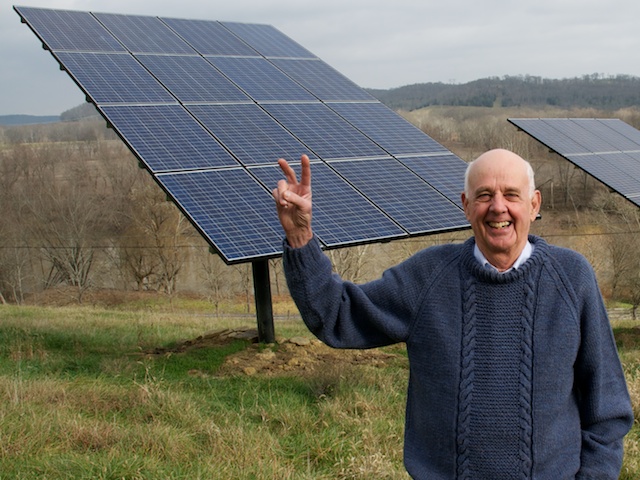


Reflecting on the life of Wendell Berry.
On August 31, 2026, the poet-author-philosopher-farmer Wendell Berry entered into eternity. In the days since, I have found myself examining his life through the lens of one of his poems, cheekily titled, “Manifesto: The Mad Farmer Liberation Front.” Berry, it seems to me, was the original Mad Farmer, a sort of agrarian Don Quixote, and the poem serves as a fitting way to consider the values by which Berry lived his life and understand the enduring appeal of his works for those who find themselves inexplicably dissatisfied with, and out of place in, 21st century society.
In 1965, on the cusp of a successful academic career, Berry gave it all up and moved to a 117-acre homestead in Port Royal, Kentucky, his family’s ancestral stomping ground. He spent the rest of his life on that land—farming, philosophizing, and writing—leaving behind an impressive body of work that encompasses poetry, fiction, and nonfiction.
“Manifesto,” as implied by the title, is a poetic statement of the Mad Farmer’s values and convictions: a tirade against rampant consumerism, an act of bold hope against all odds. It aptly captures Berry’s spirit, simultaneously both a bit curmudgeonly and startlingly optimistic.
“Expect the end of the world. Laugh. Laughter is immeasurable. Be joyful though you have considered all the facts.”
In a world that swings manically between hedonistic denial of our ills and Nietzschean despair over them, Berry found solid ground between the two extremes. His stark assessment of the state of affairs did not prevent him from claiming joy and finding beauty in the good things in life. The very act of joy, hope, and love for the ordinary became an act of resistance and revolution against a world poisoned and crippled by original sin.
“The basis of my resistance is not that I’m a crank, but that I’m satisfied,” Berry stated in an interview with John J. Miller of National Review. And that satisfaction was a small revolution in itself, against a culture that restlessly seeks the next thing but never delivers satisfaction. The contented man, in contrast, is made immune to the ravages of materialism and finds a quietude that may, perhaps, be a foretaste of the life to come.
“Ask the questions that have no answers. Invest in the millennium. Plant sequoias.”
Berry’s life is a prime example of playing the long game. He rejected “the quick profit, the annual raise, vacation with pay,” famously refusing, for the entirety of his ninety-two years, to use a computer. His farm was run without modern machinery. In a world obsessed with speed and efficiency, Berry saw the appeal in steadiness in work and thought, and the words he wrote drew many people to pursue that same slower pace in their own lives. The current economy, Berry argued, was unsustainable, and so—as far as he was able—he simply opted out of it.
“So, friends, every day do something that won’t compute. Love the Lord. Love the world. Work for nothing. Take all that you have and be poor. Love someone who does not deserve it.”
Berry was a champion of subsidiarity and the primacy of local community as an alternative to the isolating individualism of corporate America. The fictional town of Port William (the setting of Berry’s novels) is peopled with neighbors who show up for each other in times of great suffering and great joy—whether fire, flood, the birth of a calf, weddings, new babies, or funerals. While Berry was concerned with politics on the global scale, particularly in cases of war and the abuse of natural resources, his primary focus was on the communities in which we live, work, worship, and eventually, die.
What strikes me most in tracing the shape of Berry’s life is the extent to which his choices aligned with his convictions. A luxury that few can afford these days, or perhaps it would be more accurate to call it a commitment that few are willing to make. We see throughout Berry’s writings that he constantly measured his choices against the values that he held dear and was willing to give up things deemed essential by the culture in order to adhere faithfully to those values. We can say with confidence, now that his life has drawn to a close, that he was “like the fox who makes more tracks than necessary, some in the wrong direction.” Let us hope that he is even now practicing resurrection.


