
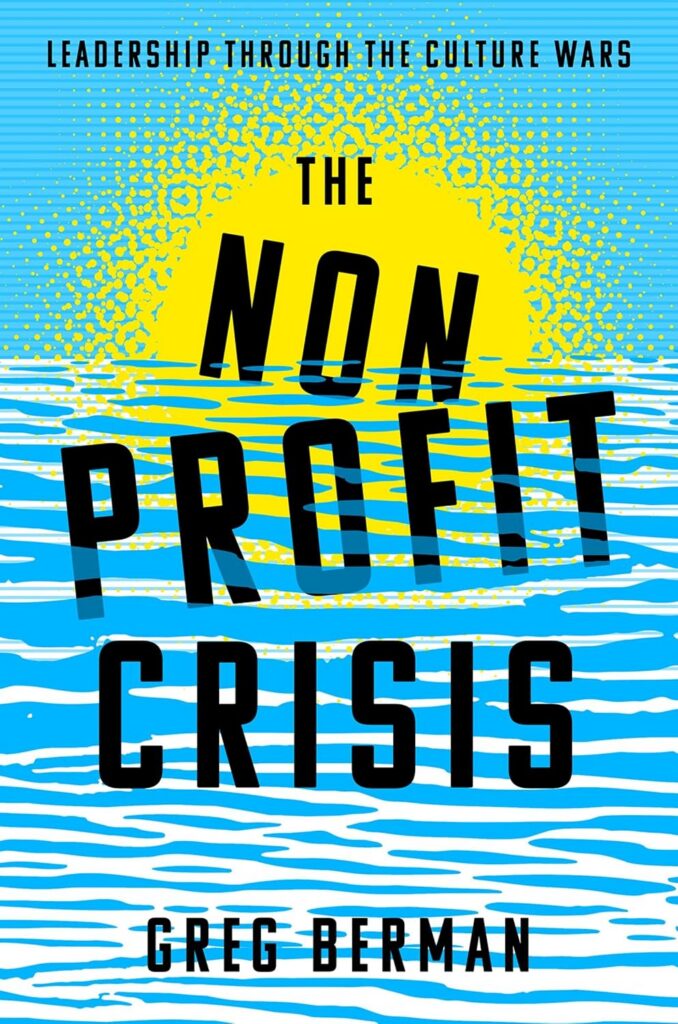


A review of Greg Berman’s The Nonprofit Crisis.
Having worked at or on behalf of nonprofit organizations for about 25 years, I’ve long been invested in their ability to thrive. Nonprofits hold a singularly vital role in our communities, and one that is foundational to the very make-up and essence of our country. However, I’ve grown increasingly concerned by a shifting focus over the last decade, one that has damaged, in the whole, their reputations and weakened their missions. I read Greg Berman’s The Nonprofit Crisis (Oxford University Press, 2025) intrigued to learn how he views the sector and what leaders can do to address its challenges.
Berman asserts that the nonprofit sector isn’t just at risk of losing public trust—it’s already happening. You know the “bad apple” analogy. He shows how mission stray, poor leadership and financial decisions, and negative media coverage for a few high-profile organizations have soured the barrel for the entire sector. Berman believes this erosion of trust is showing up in real, measurable ways, including declining rates of volunteering and charitable giving across America.
Berman is largely writing for nonprofit leadership. He calls them to acknowledge the significant changes of the last decade or so and rise to lead the sector through the “culture wars.” He argues that leaders can no longer lead organizations as they once did. Through extensive research and real-world examples, Berman addresses what needs to change and what needs to be preserved in the sector, identifying three specific challenges that must be proactively managed.
- Generational Change: Managers cite the widening generation gap as a primary contributor to changes in staff chemistry. Organizations are now forced to navigate new pain points in hiring and retention to avoid losing talent to competitors.
- Polarization: While most organizations are technically “non-partisan,” Berman notes they are rarely neutral. Political and educational polarization has created a divide between staff and leadership, complicating hiring on both the left and the right.
- Race: Ensuring diverse perspectives is vital, and Berman argues that some nonprofits have spent more time on DEI training and identifying disparities than on their actual missions, leading to a complex and often distracted landscape.
As someone who has spent nearly two decades in management consulting, these challenges resonated deeply. I have often been confounded by why highly effective organizations allow themselves to be distracted by matters outside their core mission. In truth, I have wondered how some would even keep their doors open if they continued on their current path.
So, what is a nonprofit executive to do when proven leadership methods fall short in today’s changed environment? Berman suggests that “…a moderate, thoughtful brand of management that resists capitulation to both internal and external critics” is the best path forward. He describes leadership as a “subtle art”, but he also recognizes that leaders are responsible for “good stewardship” requiring four qualities: emotional intelligence, flexibility, humility, and long-term thinking.
While every leader brings a unique perspective to these qualities, Berman advises executives to grapple with difficult questions: How are decisions made? How can we mentor today’s staff without backlash? How can we avoid mission creep? When is it time to step down and hand the leadership reins to someone else?
The book explores each of these questions constructively, offering a roadmap for nonprofit leaders who need to revitalize their organizations. I appreciated Berman’s attempt to stay neutral and provide a balanced, non-political portrayal of the sector. However, there were moments when I wanted him to drop the neutrality and commit to telling the reader what he really thought. His restraint is admirable, but perhaps a bit too safe for the gravity of the situation.
That said, his conclusion pulls no punches: “. . . the warning lights are flashing yellow. The crisis is upon us. Now is the time to move with purpose to strengthen trust in nonprofits.”
For an executive leader, The Nonprofit Crisis provides a necessary opportunity for self-examination. It forces a hard look at who’s driving the organization and whether the mission still comes first. It is a call to act with urgency, addressing the challenges of the present to ensure the sector remains foundational to the future of our country.
Lindsay Anderson is a vice president at AmPhil.